Scanned 300 Family Photos Last Weekend: The App That Brought Our Memories Back to Life
Have you ever held a shoebox full of old photos and wished you could actually *see* the stories again? Last weekend, I did just that—digitized over 300 faded family pictures in hours, not days. With one simple scanning app, blurry grandparents, childhood birthdays, and forgotten vacations came alive on my screen. It wasn’t just about storage; it was about reconnecting. This is how technology quietly healed a piece of our family history. And if you’ve ever looked at a stack of yellowed snapshots and felt a pang of guilt or sadness, I promise—you’re not alone. This isn’t just a tech story. It’s a story about love, loss, and the little ways modern tools can help us hold on to what matters most.
The Dusty Shoebox No One Wants to Open
There’s a shoebox in my closet that’s been sitting there for over a decade. It’s not fancy—just a plain cardboard box, the kind you get from a department store, slightly dented on one corner. Inside? A lifetime. Faded color prints with curled edges, black-and-white portraits of people I can barely name, a handful of negatives tucked into plastic sleeves, and a few Polaroids that have turned pink with age. For years, I avoided opening it. Not because I didn’t care, but because I *cared too much*. Every time I lifted the lid, I felt overwhelmed—by the sheer volume, by the fragile state of the photos, by the stories I knew I was losing.
My kids started asking questions last winter. “Who’s that lady with the big hat?” my daughter asked, pointing to a woman standing beside a station wagon in a 1972 photo. I stared at the image, squinting. “I think… that might be Great-Aunt Marge?” I said, unsure. That moment stung. How could I not know? These weren’t just strangers in old clothes—they were part of my story, part of *our* story. And yet, time had turned them into ghosts. The real problem wasn’t the clutter or the disorganization. It was the slow, quiet erosion of memory. These photos weren’t just paper. They were proof we existed, laughed, loved, celebrated. And they were disappearing—one crease, one faded corner at a time.
I kept thinking about how my grandmother used to tell stories while flipping through albums. She’d point to a man in a sailor’s uniform and say, “That’s your grandpa, right before he shipped out.” Or she’d laugh at a photo of my dad as a boy, covered in mud. Those albums were more than collections—they were living history. Now, those albums are gone. The photos are scattered, tucked into drawers, forgotten in boxes. And with them, the stories fade too. I didn’t want my kids to grow up not knowing their roots. I didn’t want to be the generation that let the past slip away.
How a Simple Scan Turned Chaos into Clarity
I’d heard about photo scanning apps before, but I always assumed they were for techies with fancy equipment. I pictured scanners the size of printers, complicated software, hours of fiddling with settings. So when my friend Sarah told me she’d scanned her entire family collection using just her phone, I was skeptical. “It’s like magic,” she said. “You just take a picture, and it turns into a clean, clear scan.” I rolled my eyes—until she showed me her results.
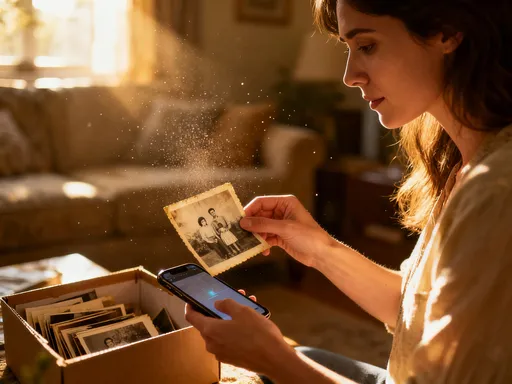
That weekend, I finally gave it a try. I cleared off my bed, turned on the overhead light, and pulled out the shoebox. I picked a photo at random—a birthday party from 1985. My cousin, maybe five years old, blowing out candles on a cake shaped like a race car. The photo was creased, slightly faded, with a glare across the middle from years in a plastic sleeve. I opened the app, framed the photo in the camera viewfinder, and tapped the screen. The app instantly detected the edges, snapped the shot, and within seconds, presented a clean, straightened version with the glare gone and the colors gently enhanced. I blinked. It was like the photo had been reborn.
I zoomed in. I could see the sprinkles on the cake. I could see the joy in my cousin’s eyes. I could see the texture of the tablecloth. And there, in the background—my grandmother, smiling, her hands clasped together. I hadn’t even noticed her in the original. That moment hit me like a wave. This wasn’t just digitizing. This was *remembering*. This was *connecting*. I didn’t just save a photo—I rescued a memory. And I did it in less time than it takes to brew a pot of coffee.
Why This Changed More Than Just Photo Storage
At first, I thought this was about organization. About finally getting those photos off the floor and into some kind of order. But what happened next surprised me. I showed the scanned photo to my mom. She took one look and burst into tears. “That’s your dad’s last birthday before he passed,” she said, her voice trembling. I hadn’t even realized. That simple image wasn’t just a party—it was a final moment. A last celebration. And I’d almost missed its significance.
That night, we sat together, going through the first batch of scans. My mom told stories I’d never heard—about my dad’s terrible singing, about how my aunt once spilled punch on the cake, about how my grandmother always made sure every kid got a piece, no matter how small. These weren’t just facts. They were family legends. And they were coming back to life.
I started sharing the digital albums with relatives. My sister called me the next day. “I saw that photo of us at the lake house,” she said. “I forgot how much fun we had that summer.” My kids began asking different questions. Not just “Who’s that?” but “What were they like?” “Did they laugh a lot?” “Did they love us?” I realized we weren’t just preserving images—we were rebuilding a sense of belonging. The app didn’t just organize photos. It became a bridge. A quiet, gentle bridge between generations. And for the first time in years, I felt like our family history wasn’t slipping away. It was being handed down.
How We Scanned 300 Photos Without Losing Patience
Let’s be honest—scanning 300 photos sounds like a nightmare. I was worried I’d burn out after fifty. But here’s the thing: it didn’t feel like work. Once I got into a rhythm, it became… peaceful. Almost meditative. I learned a few tricks that made all the difference. First, I worked in small batches—about 20 photos at a time. I laid them out on the bed, made sure the room was bright (natural light near a window works best), and used my phone’s flash only if absolutely necessary.
The app’s batch mode was a game-changer. Instead of scanning one photo, tapping “save,” then moving to the next, I could snap continuously. The app automatically detected each photo’s edges, cropped it, adjusted the lighting, and saved it to my album. I didn’t have to do anything but keep shooting. It felt like flipping through an old album, only now, each page was being preserved.
I created folders by year and event—“1980s,” “Beach Trips,” “Holidays,” “Grandparents.” My teenage daughter joined in, turning it into a challenge. “Can you find a photo from before 1970?” she’d ask. “I’ll scan the oldest one!” We laughed, we argued about who that man in the fishing hat was, we marveled at fashion choices we’d never understand. What could have been a lonely, tedious task became family time. And the best part? No pressure. No deadlines. Just us, the photos, and the stories waiting to be told.
Beyond Photos: Scanning Letters, Tickets, and Forgotten Keepsakes
Once we got started, we realized—why stop at photos? My mom pulled out a bundle of letters tied with a ribbon. Love letters my parents exchanged when Dad was stationed overseas. Handwritten, smudged in places, the paper thin and fragile. I scanned them one by one. The app didn’t just capture the images—it recognized the text. That means I can now search for “Vietnam letter June 1968” and find it instantly. I can read Mom’s looping script on my phone, even if the original paper someday crumbles.
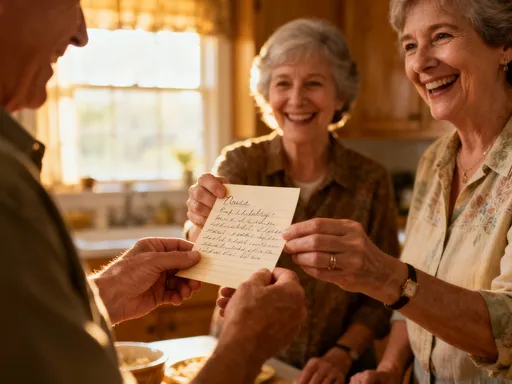
We scanned concert tickets from my teenage years—The Cure, 1991. My first paycheck stub. My childhood report card with the teacher’s note: “Loves to read, but talks too much in class.” A pressed flower from my wedding bouquet. A recipe card in my grandmother’s handwriting: “Blueberry Cake—don’t overmix.” Each one, scanned. Each one saved.
These aren’t just digital copies. They’re digital heirlooms. They’re safeguarded against fire, floods, mold, and the slow decay of time. And because they’re searchable, they’re *usable*. I can share my grandmother’s cake recipe with my daughter. I can show my son what a concert ticket looked like before everything went digital. These artifacts tell our story—not just who we were, but how we lived, what we loved, what made us laugh. And now, they’re not locked in a box. They’re alive, accessible, ready to be passed on.
Keeping It Private: Security That Lets You Breathe Easy
I’ll admit—I was nervous about privacy. I’ve read the headlines. Data breaches. Hacked accounts. Companies selling personal information. The thought of my family’s most precious memories floating around on some server made me uneasy. But the app I used takes privacy seriously. Everything is encrypted—both in transit and at rest. That means even if someone intercepted the data, they couldn’t read it. And it’s stored only in my personal cloud account, not on the app’s servers.
There are no ads. No algorithms analyzing my photos to sell me something. No facial recognition pushed on me unless I choose to enable it. I control everything. I decide who sees what. When I shared a photo album with my sister, I generated a secure link with view-only access. She couldn’t delete anything. She couldn’t download everything at once. Just view, enjoy, and connect.
And if I ever wanted to delete something? One tap, and it’s gone—permanently. That level of control made all the difference. This wasn’t about uploading my life to the internet. It was about creating a private, protected space for my family’s history. A digital attic, if you will—safe, organized, and always within reach. For the first time, I felt like technology was working *for* me, not against me.
This Is What Tech Should Feel Like: Quiet, Kind, and Meaningful
We talk a lot about how fast technology moves. How it distracts us. How it pulls us away from real life. And yes, sometimes it does. The endless notifications. The addictive scrolls. The pressure to keep up. But this experience reminded me that technology doesn’t have to be loud. It doesn’t have to demand our attention. Sometimes, the most powerful tools are the quiet ones. The ones that don’t shout, but whisper. The ones that don’t replace human connection, but restore it.
This scanning app didn’t make my life faster. It made it *fuller*. It didn’t replace storytime with my kids—it gave us new stories to tell. It didn’t erase the past—it brought it into the present. And in doing so, it helped me feel more grounded, more connected, more like myself.
I think about my grandmother again. If she could see this—how her face, her voice (in the stories we now tell), her love is preserved not in a crumbling album but in a device that fits in my pocket—what would she say? I like to think she’d smile. Maybe cry a little. And then she’d say, “Keep going. Keep remembering.”
Because that’s what this is really about. Not apps or scans or cloud storage. It’s about love. It’s about legacy. It’s about making sure the people who shaped us aren’t forgotten. And it’s proof that sometimes, the most meaningful tech isn’t the one that changes the world—it’s the one that helps you hold on to yours.